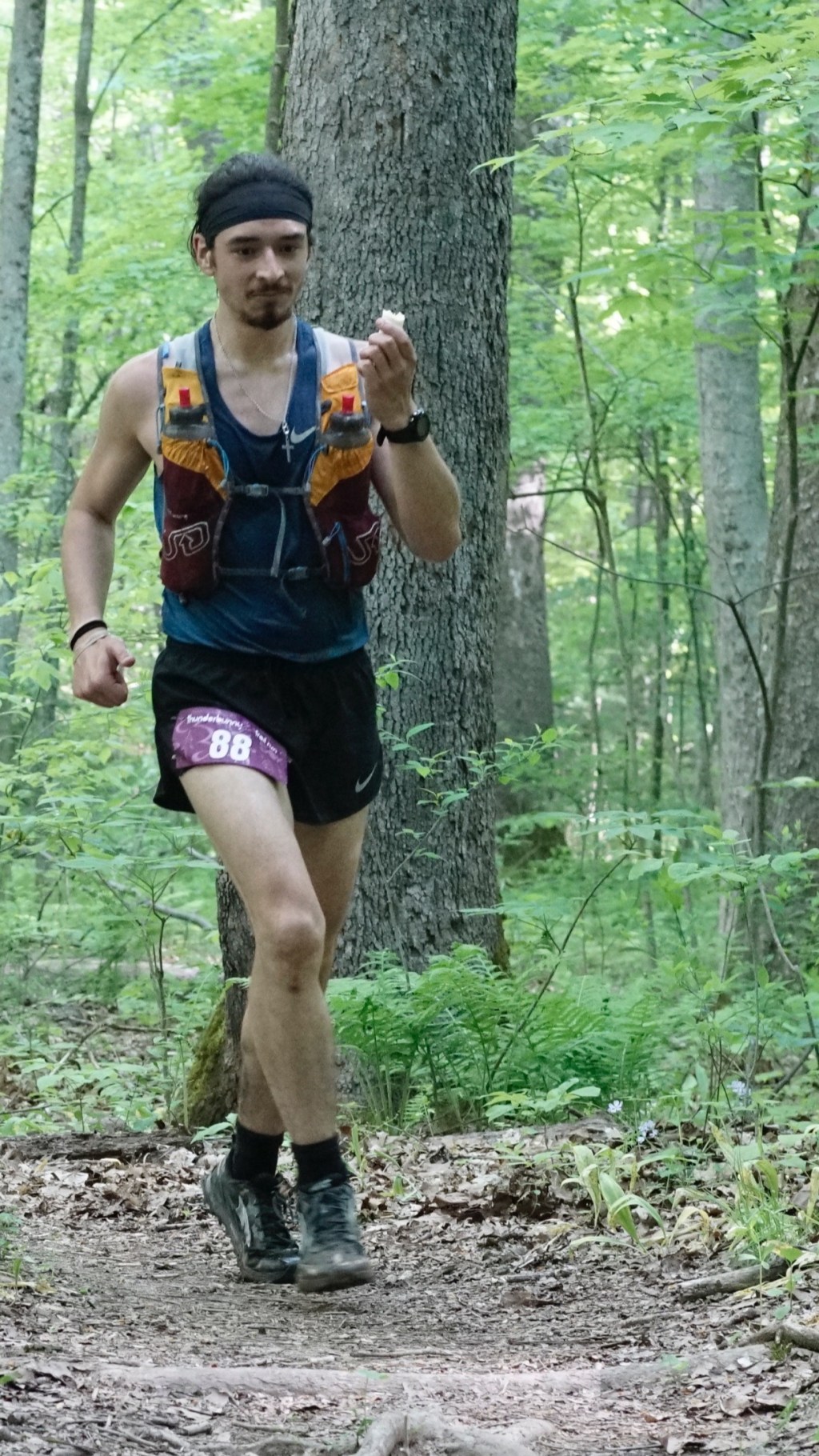
A previously unpublished essay about how I found running – it feels a bit dated reading over it again now, so I figured I’d might as well publish it here.
I think that people assume that I like running because it doesn’t hurt when I do it. They’re wrong – it almost always hurts. Sometimes when I’m running I’ll listen to the little bells of pain that ring off in my body and count them up, trying to beat old records for how long I can ignore them. It starts in the right big toe, then moves across my body to the side of my left foot, then up into my right shoulder and elbow, then down into my right hip, a seemingly constant problem area, hopping across after that to the front of my left knee. Running hurts. People shouldn’t like it for exactly this reason, but millions of people keep making the same lame excuses as I do to follow our selfish hobby, one that leaves us alone for hours at a time, often when we should be doing something else, wearing ridiculous clothing, hurting.
I started running because I thought I was getting fat. Saying that to people feels like ripping a band-aid off. I feel the need to clarify: There are millions of incredible reasons to run and none of them have anything to do with weight loss, and you don’t have to be skinny or fit to be allowed to enjoy the physicality of your body. But, when I started, I wasn’t thinking about any of that. I started running because I thought I was fat, because I was afraid of getting fatter, and because I wanted to be skinnier.
My father is fat. A lot of Chicanos like us are, and I could go on for a while here about the effect of cortisol or glucocorticoids on the body and the socioeconomic and racial factors relating to stress and health in the United States as a way of explaining his fatness so that it seems all but inevitable, a wonder that maybe his or my health isn’t worse, but at the time all I knew was that my father was fat, and that I didn’t want to be fat because I didn’t want to be like my father even though my mother promised me I would never be anything other than a wife-beating spic just like him.
Some of my earliest memories are of being told how much I look like my father. I used to take so much pride in that, being the most like him of my siblings, the most Mexican. It wouldn’t take long for that to start feeling perverse and for me to get bitter about that comparison. By the time we were all in elementary school, my parents stopped seeing my brother and sister and I as their children and rather as tools that they could use to hurt each other when their fists could no longer do the damage they wanted. They taught me that love was the expectant silence between the outbursts of violence and hate.
At the start of my life, being Mexican was interesting. I taught the other elementary school kids the few Spanish words I knew. Huevos, tienda, manzana, puta. My skin would get dark in the summer and then lighten up as Ohio’s seemingly never-ending winters set it. I was dark enough that when I first went to kindergarten, some of the girls called me the little brown boy. They quickly learned other things to call me that meant the same thing, like beaner or wetback. The only people that my brown-ness didn’t seem to matter to were my white grandparents, mother’s-side, and almost every Sunday after church during my boyhood my grandfather and I would hike around in the woods near their home, doing everything from tracking deer to catching snakes to picking blackberries, and when I was doing that there was nothing else that I would have rather been doing.
&
The problem with Southeastern Ohio is that it’s so damn beautiful; you want the people to be the same way. The last foothills of America’s oldest mountains, the Appalachians, mountains older than Saturn’s rings, folding themselves in and out of brilliant river valleys, trees exploding with foliage that shades the sunlight into little miracles, rock formations cut by singing creeks turning washouts into sweeping vistas and cavernous waterfalls. Climb to a ridgetop to get a lay of the land, and you’d swear the world is rolling out from underneath your feet like rumpled carpet. Do it at night, and you’ll be reminded that all the stars in the sky were lit just for you.
After I started running, I decided I wanted to run ultramarathons because it seemed like the sort of thing that the people I wanted to be like would do. I could kill two birds with one stone: Get in shape, spend more time in the woods. And it was going to be hard; hard enough that it seemed like it would be good for me. Why would anybody choose to do easy things when you could do hard things instead?
&
I prefer to run on what’s known as single-track, shoulder-width trails that float up and down constantly in the foothills where I grew up, that twist their way over ridgetops like a snake uncoiling from itself. In the winter the snow and ice will send you slipping to all fours, in the spring briars will claw at your exposed thighs, in the summer you’ll be encased in the spiderwebs you’ve ran through and covered in bug bites, but through it all the motion itself carries you forward, thinking about nothing and everything all at once, not really noticing until you realize you’re only a half mile or so from the parking lot you started at.
The best place for single-track near Columbus is Alum Creek State Park. While it’s flatter than I’d like it to be, there are enough rocks and roots to trip over that I ran there a few times a week for about two months when I first started and didn’t make it an entire six mile loop without tripping and falling down at least once.
The worst thing about Alum Creek is that it’s smack dab right in the middle of a wealthy suburban subdivision. At least, it seems wealthy to me. The McMansion is in the eye of the beholder, I guess.
Running at Alum Creek in the fall or winter, without the leaf coverage, you can see the little squared-away plots with their matching bright new cars and perfectly manicured grass between the trees. The fact that they let it grow wild right outside their backyards astounds me. I know they can’t stand to see the whitetail deer eating their flowers; they petitioned the city for an urban hunting season to deal with the issue, and the Ohio Department of Natural Resources gives away tags on a lottery to local bowhunters.
One time, after deciding to explore some deer trails off the main trail while running out there, I popped out of the forest and right into a man’s backyard, not realizing what had happened until I was standing shirtless and panting on the man’s lawn. He waved at me from a riding mower, hairy-chested and beet-red in the sun. I turned around and ran away, back into the woods, without waving back.
&
From about my freshman year of high school on, I lived in a body that rapidly fluctuated in weight, with absolute maximum and minimums of 220 and 140 pounds, all in the name of American Football. At times, I lifted weights three times a day and tried to stuff down a whole gallon of milk and eight other meals during my waking hours. My body was never, could never, be enough for me. No amount of deadlifts or power cleans would ever make me the man I needed to be. I was tweener, too small and weak to play well on the lines and too slow to play a skill position. A Nike Combine assigned a very low numerical score to my abilities as an athlete, and the only college that gave me any attention was a Little Ivy in an Amish-country cornfield that won one game a year.
Once I actually entered college, it was a school in Chicago full of the suburbs’ finest richest whitest folk. I had no idea what I was doing, or why exactly I was there in the first place other than it seemed like a better idea than working on an oil rig or going to vocational school, and this way I at least got to leave Tuscarawas County too.
I stopped shaving my head in preparation to wear a football helmet and my hair burst into a pile of tight, black curls that I covered with baseball caps. People always asked if it was my “natural hair”; I resented that.
I wore hats a lot. I was afraid of how much haircuts cost in the city, of the city in general, frankly, and I couldn’t afford it anyways.
&
This all started to come to a head not long after I realized that I couldn’t figure out what my body actually looked like using a mirror, after I had tried and failed to cure my inability to think and act like everybody else with alcohol and psychedelic drugs, with the visions promised to me in what I’d read about them. I did my best to not think about what color my skin actually was when I first showed up at college. Awash now in terms I had never heard before, both privileged and oppressed, and I couldn’t seem to squeeze a halfway decent explanation from anybody about it. It was something that they had already been taught, and I was behind the eight–ball not knowing. They made it seem like a miracle that people lived in bodies at all, what with all the new things I had to learn just to justify living in mine. Suddenly, I was white and spoke with an accent nobody had heard before, an accent I didn’t quite recognize but worked hard to rid myself of. I never had to deal with any of this before I left Uhrichsville.
At the same time, crash diets ebbed and flowed through my life, along with all the pills I could find. I tried keto, Xanax, intermittent fasting, Percocet, paleo, Vyvanse, the slow-carb diet, Lamictal, even being vegan and Seroquel. Each one of these promised me results with speed I couldn’t fathom and each one ended and started in tune with the others, with extremes that ostracized me from being able to eat with my friends without extreme guilt, isolating and starving myself, and then self-admonishment and binging over that guilt and isolation and starvation
Those first few weeks, it felt like my head and my gut belonged to a whole new person.
I would berate myself about every aspect of this while it happened; rapid deconstruction in real time. Why did I care so much? Why couldn’t I just let my body be my body? Why couldn’t I accept the symptoms of my mental illness and just let them go, stop judging myself for them? I knew that’s what I should have been doing all along, but since when did knowing better stop anybody? Irregular nights full of alcohol followed all along the way, cheap bourbon and cheaper beer, the harsh fluorescents above my bathroom mirror turning my skin sickly pale and green, a shade I never saw as a boy.
&
Step one of ultramarathon training was learning how to eat and run at the same time. Those were two of my favorite things, I thought, so why not try to do them both at once? Of course, people eat all kinds of weird shit during ultramarathons. Why wouldn’t they? I tried every single dumbass thing I read about online. Ziploc bags full of mashed potatoes or bananas, expensive maltodextrin pastes packed full of science, travel-size packets of baby food, flat Coke, Ginger-ale, Oatmeal Creme Pies, Oreos, all the junk food your parents told you wasn’t good for you but still let you eat anyways.
I understand now that it’s really weird in a way, that I started a hobby to get healthy and now I own a special vest that holds not only water bottles and little rain jackets that fit into their own pocket but also Snickers bars, peanut M&M’s, Ziploc baggies of tortillas filled with Nutella, and basically all other kinds of shit I probably shouldn’t be eating if I really do care so much about my physical health. Then again, if I care so much about my physical health, who told me it was a good idea to decide to commit my limited free time to racing distances longer than just your run-of the-mill, twenty-six point two mile marathon? Not just that, but doing all of that through the woods or mountains, in all kinds of terrible weather, meanwhile eating all kinds of junk food, feeling great for a while until hitting a bad patch and wishing endlessly for the sort of sweet release that only death could bring until the race ends.
&
Octavio Paz, a Mexican writer and Nobel Laureate, says that people of Mexican origin in the United States, or at least in Los Angeles, have the restless air of people in disguises, that with one look somebody could pluck our clothes right off and we would be left standing naked in the street, our other-ness so cleanly exposed. I don’t think it’s always that simple. I’ve never had a game warden ask me about my national origin, but that hasn’t stopped doctors or nurses. The university wanted to know when I applied, but I’m hoping that had nothing to do with them letting me in. I do know that it seemed very important to them that I was “a Hispanic” at the alumni association dinner I attended after accepting their scholarship.
The rest of Paz’s work are filled with pithy sentences like: “Americans drink to forget. Mexicans drink to confess.” As a Mexican-American, I must drink to forget that I have things I need to confess.
What I mean by that is that there are things that I do that I do not yet fully understand that I intend to write myself into an understanding of. I mean that I wish I could write about running without having to write about race, without having to explain myself, in greater detail, in greater fear of being misunderstood. My connection to Mexico often feels like an umbilical cord – it was what made me, me, but now it’s cut and tied off into a neat little package deep in my private life so the people I meet don’t have to look at it.
&
Before a run at Zaleski State Forest, I take stock of my body in the mirror formed by my truck’s rear door, pouring sugar-free Red Bull into my mouth and pulling at the deposits of fat that sit just above my hips, where my bottom two abs would be. Stretching my left arm up above my head lets me run my right fingertips along the now exposed ribs. Strong legs and lungs and heart, I think, but belly still a little swollen from too many Modelos and too much ice cream, eating through the GPA-induced stress. Today though, my body seems to be enough. Twenty-six miles, more Red Bull, eleven energy gels, a Clif Bar, and four salt pills later, I lay down in the grass next to my truck totally wasted from exertion, letting some folks blow cigarette smoke into my face when they pull their motorcycles over to ask me questions about how to get to Old Man’s Cave.
The next day, full of ibuprofen the way I was during two-a-day football practices, I ran six and a half miles to Antrim Park from my apartment, then back again for a thirteen mile day in total. The whole time so numb my legs don’t feel like they’re moving, but never dipping below a pace of nine minutes per mile. Mania, or a well-executed peak training week in preparation for a race? I still can’t tell. Painful, often destructive excess seems to be a symptom of both things.
&
After my freshman year of college in Chicago, I transferred to Ohio State, a fuck-up trying to turn things around, but it seemed that way only in my head. Nobody worries if the kid with the 3.9 GPA is going to be dragging body dysmorphia and cPTSD along behind him in a slimy trail. Nobody asked if my diet got its micronutrients from some place other than Wild Turkey and Marlboro Lights – even though that didn’t matter to me at the time. I was just doing what all the writers I had ever loved did.
At OSU, I was living in a high-rise building across the street from campus with five guys I hadn’t met before. I knew I had work to do, but I bought the first case of Natural Ice beer and stuck it in the fridge. I struggled with new medication, with the tiny amount of sleep I got between school and work, taking naps on the benches in Denney Hall before my first ever nonfiction writing workshop. I only took that class because none of the fiction workshops were left open. The great American novel I was convinced I was going to write when I was in the middle of the worst of it wasn’t going to happen anymore, but maybe I could actually make a living doing something I liked, something that could help me make sense of the life I had been handed. I became a double major in Anthropology and Creative Writing and imagined climbing mountains in faraway places, of living life in the way I was least taught to live it, learning everything I could from people who still lived in the places my ancestors did.
A couple days after I first moved in, while all the bright-eyed freshman moved into their dorms, my friend Mitch and I went to a house that had a bedsheet hanging from the roof that said YOU HONK, WE DRINK, GO BUCKS! Parents honked as they dropped off their kids, and we drank. It was all a big joke, so I pretended that I got it and laughed with everybody else. Mitch took my favorite hat, and a girl told him the blue color brought out the blue in his eyes, so he kept it. The hat didn’t match my eyes; they’re the color of mud.
People didn’t stop honking, I drank until my mind started letting me act like everybody else, until time got slippery and moved in flashes and starts, until I could go back to my new apartment and sweat the booze out from the holes I wanted it to drill in my skull.
&
Cultural Anthropologist James Diego Vigil calls Chicanos like us the in-between people, and I don’t think that term ever felt like it fit until just recently, when I realized that it was less about being in-between the dominant racial categories of the United States and more about living in an in-between culture, a body that signifies the border itself, the kind of thing Gloria Anzaldua is saying when she says that we are the new mestiza, except she says it in three languages at once and her books confuse you at the same time they enlighten you about yourself.
Looking in the mirror makes all this the more confusing. Should I have this many freckles on my upper back? Is it really true that people with Latin American roots are genetically predisposed to carrying more weight in their midsection? Does the peak of my nose mean Mayan royalty, or European conquest? Unlike what your schoolbooks or the History Channel told you, Mayans still exist. And I’m not one of them. Can I piece and part out my ancestry by picking at my body parts in a mirror, with another fad diet that promises me six-pack abs and the confidence that maybe I’ll finally have with them?
This essay was workshopped exactly two years to the date after I found out about ultra marathon running. I didn’t plan on that to happen, the same as I didn’t plan on being swarmed and overwhelmed by a massive group of people all hustling past me when I was out backpacking. I didn’t start the next day, but that planted the seed; they all seemed so damn happy, no matter how hard they were working as they floated and skipped their way ahead of me on the trail, all of them offering hellos and howdys and how-are-you-doing-young-mans even thought they were moving too fast for me to really answer them.
&
Most of the time, I don’t listen to music when I run. It helps though, so I do sometimes. As I write this I’ve been listening to the song “Goddamn Lonely Love” by the Drive-By Truckers on repeat. Playing songs on repeat helps me write. It’s a sad Appalachian kinda song – but I don’t quite think this is a sad essay. Just parts.
During my first marathon, a trail race just outside Cleveland, I tried to not listen to any music when it started, so I could save it for when things got tough, for when I would need it. The first part of the race was weird; all the volunteers and other runners were talking to me like I was already their friend, laughing at the stupid jokes I made because I was nervous, telling me I was doing great even when I was only running ten minute miles and walking up most of the hills, even though my body didn’t look anything like those of the men who were leading the race from the front.
After the twentieth mile, right when I had been told it would come, I ran face first into The Wall. The way people had talked about The Wall was real, I immediately learned that nobody had been lying to me about that. It felt like someone was using my hamstrings as the cords on a fiddle and the bow was a hacksaw. I came up on the biggest downhill of the day, overlooking the whole park and trail system, pressed shuffle on my running playlist, heard 2Pac say “It wouldn’t be LA without the Mexicans” and immediately burst into tears. As silly as it feels to write that now, it felt like a lot that he would’ve put that into the song just for me to hear then, even though it was written well before I was even born. I’ve never even seen Los Angeles, but that day in a metro park a few thousand miles away, it was a home that I never knew existed for me.
What I didn’t realize at the time was that this place, these people at these races, they were the home that I never knew had existed, something waiting for me to find, something that didn’t care what baggage I was bringing to it. All I had to do to be accepted was show up to the race and not act like a dick.
At the first aid station after mile twenty, I ate some potato chips and a banana, hoping that salt or potassium would solve the cramping in my legs. In my hurried, fidgetingly emotional state, I forgot to get any water before I left and only realized after I’d gone way too far to turn back.
Well, things can only go so much more wrong than they already have, I thought, and then slipped and landed on my hands and knees in a mud puddle.
The thing was, even during those most painful moments, I laughed when I saw the other runners and the volunteers. I smiled. It was the most painful fun that I had ever had, and I didn’t even wake up with any spiders in my tent on the morning of the race. I couldn’t believe that a race entry fee and sweat could buy that much happiness.
I promise I only cried a little while driving home.
After I made it back to my apartment, I drank three large Gatorades, ate a whole large pizza, and made sure to wash all the mud off my body in the shower past the stuffed full bulge of stomach before falling asleep at 3PM and sleeping for the next sixteen hours.
&
From the time I started, running quickly become the only part of my day that I really feel like belongs to me, a time when I can listen to music or not, a time when I can run through the woods or in neighborhoods I’ve never seen before. Fueled by black coffee, and sometimes Pop Tarts for those really long days, I get to be me, without having to ask any permission. I get to belong to my body, with joy or anger or hate or frustration, whatever it is I’m feeling, without navigating its politics.
I don’t want to say that running lets me eat whatever I want, or that running solved whatever mental illnesses that I continue to suffer from, because neither of those things are true. I know that running can modulate the dopamine output in people, dopamine output of course being directly linked to my mental illness, but I don’t actually care if that’s what it’s doing. I know that most of the time, running knocks the scariest peaks and edges off of my life, that it represents a center within myself to return to when things get rough. I know that running has carved my body into a different version of myself, maybe one that people who haven’t seen me in a while wouldn’t recognize. But more than that, more than anything I think, running has taught me how to live in a body like mine, and how to love a body like mine – not because it deserves to be loved, because of where it’s from or what it looks like, but because it’s mine, and because I am worthy.
&
Today, writing this, procrastinating writing something else that has a deadline, I built myself an impromptu office with reclining chairs on the sixth floor of the library. The windows in front of me rain streaked and looking out over the trees of the Oval, behind me sitting various copies of ethnographic work about Mexico. Anthony Bourdain just killed himself, Gloria Anzaldua’s Borderlands: La Frontera is open on my lap, and I’m supposed to be doing ethnography over the next two months because a diversity program hooked me up with a stipend and the opportunity to make academia just a little less white. I can’t manage any of that today, unable to process anything outside of the depth I can feel underneath the cold chair I sit in as I type this. I reread old essays about my mental health, the suicides of friends and my grandfather, my own suicidal ideation and tendencies. Today feels like a perfect day to let it all hurt, all those knife cuts inside finally opening up, wanting the glass-shard borders of my own life and body to explode into some sort of literary rage in a poetic form that I cannot control or master. Pure art. But that doesn’t happen, and the clouds clear out while summer Ohio rain keeps falling, it always fell that way back when I was a boy, back before all the inherited wounds were opened up and closed and opened up again by each day’s new events, each turn of phrase and piece of data that I hope will draw me closer to being something more like myself.
I go downstairs and treat myself to the luxury of a burnt tasting, $1.75 campus coffee, and make sure to pass by the Olmecian script inlaid onto the floor by the stairs. It’s a reminder to myself that the ancestors aren’t nearly as far away as I always seem to think that they are, that my body belongs in these academic spaces as much as I belong to my body. Back in my makeshift office, rubbing salt from my eyes, I decide that I’m in the process of becoming the man that I needed to raise me when I was a boy, and decide to write that down somewhere where I’ll remember it.
&
For the longest time my whole identity was built out of the things that had been done to me, out of the things I had been told about myself. And I have to admit, I was scared to be more than a poor kid from a broken, mixed-race house in Appalachia. People seemed to respect that in a way that they never respected me. But now, more than any of those things, I’m a runner, sometimes more than I’m even a writer or an anthropologist or literally anything else.
The writing advice I get most often is about stakes. People always think that I write them too high; I wish there was a way for me to write my fear of who I used to be into each piece, the fear that each word isn’t making me a little bit better, a little bit less broken, that each day I’m not moving forward. Relentless forward progress, like the title of that book I bought back when I started this whole process, called “Your guide to training for ultramarathons”. An inch, a centimeter, then miles and miles, each day grinding expensive shoes and my joints into oblivion, because eventually I won’t be able to, and because I’m going to use up my body while I have the chance, while it’s still mine.
 Cam rentsch
Leave a comment