An essay from a 2018 writing workshop, all the way back when I was a student at Ohio State
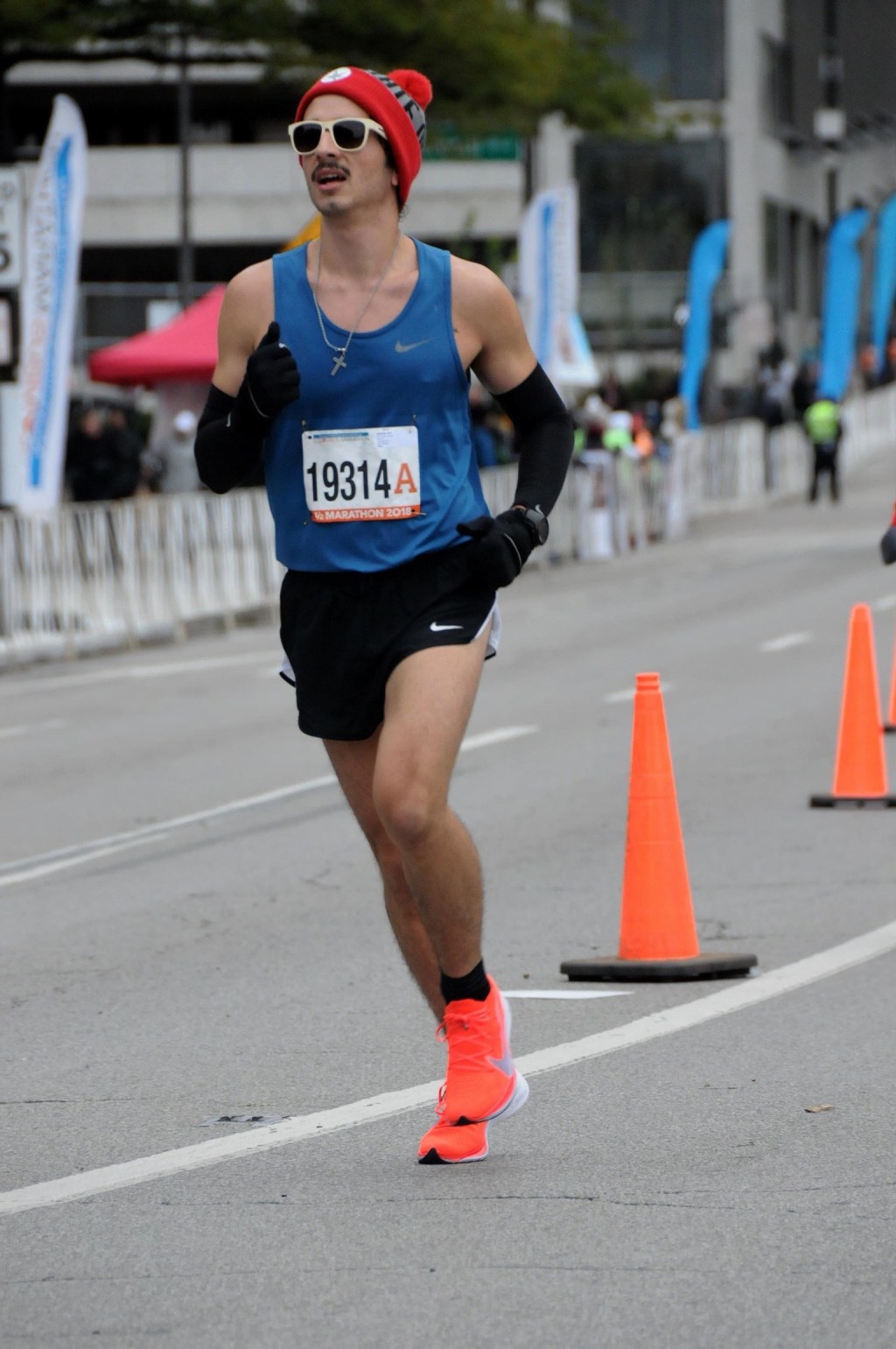
These shoes are bright red. Or salmon. Or fire-orange. Whichever color you see, they’ve got a carbon-fiber plate between the sock-like upper and the sole made of foam originally used in military aircraft, with the unmistakable Nike swoosh in white on the side. Stiff yet supple, you can’t bend them the way you do a normal shoe, but I’m almost certain I can jump higher when I’m wearing them. Right after I bought them at the Columbus Marathon Expo, fairly stoned, I wore them around my apartment, feeling bouncy and giddy and lighter than I should have given that I was significantly deeper in credit card debt. What kinda dumbass spends half a month’s rent on shoes for road races when they’re a trail ultramarathon runner?
The kinda dumbass I am, apparently.
But seeing these shoes at the expo must have been a sign – and them somehow still having my size when the entire run of shoes sells out online in minutes after they released was certainly one of those little everyday miracles we take for granted, something as innocuous as sunshine. These shoes are something I never could have gotten my hands on without luck on my side or my REI Mastercard in my pocket. An Olympic trials marathoner told me that I looked like a kid on Christmas day as I stood in line to buy them, offering to take my picture, making me even further regret shaving off most of my beard in favor of a race day mustache a friend swore would make me faster.
Slipping them on again now at my desk, I’m sure these are rocket ships, almost nothing like the other shoes I own, even the other running shoes. Part hope of humanity, part product of science, part labor of love, part act of faith. Say what you will about Nike’s politics, about the reality of their factories and global supply chains, but wearing these shoes makes you forget, at least for a moment, about all of that. Because you’re thinking about yourself now, and about being fast.
Of course I’m talking about the Nike Flyknit 4% marathon shoes. What else? The result of unrestricted capitalism and the unrelenting quest for the near impossible dream of a sub-two hour marathon, these aren’t just any shoes; these are the shoes.
*
I wore them earlier today for the Columbus Half Marathon, closing fast and hard while feeling like my sides were being pressed in a vice and half-deranged, body locking up with acid while I muttered little mantras designed to keep my mind from shutting off as all the blood I could spare went into my lungs and legs. In the windows of the buildings we passed and in the eyes of the volunteers on course, you could see them, bright streaks of light like jumping trout on my feet, looking almost comically large on someone my size. I felt like death, or maybe a Corvette.
*
I vaguely remember a movie from my childhood called “Like Mike”. It was, like a lot of movies we watched then, about a poor kid who goes on to do bigger and better things – American Propaganda on the Disney Channel. The kid in this movie in particular gets a pair of Michael Jordan’s shoes and suddenly starts to play basketball like Michael Jordan. I don’t mean in his style of play – I mean this roughly junior high age boy eventually ended up playing in the NBA in the movie, despite probably not even having hit puberty. The shoes gave him Michael Jordan’s athletic talents, but he ends up losing them or they are stolen and some drama ensues in which the lesson, I think, was that he had the ability all along, that the shoes were just a placebo, or maybe that with hard work he could get the skills the shoes gave him later in life. I don’t want to Google it now or spend too much time thinking about it, but the 4% shoes reminded me of that, of a time when I also thought about how a pair of shoes could make all the difference in the world.
The 4% shoes also make me think about the original “It’s gotta be the shoes!” commercial with Spike Lee, the one for the Air Jordan V’s, a pair of shoes which I have never owned but have always thought were very cool in an abstract way, like the architecture of a stone government building or a very long bridge. Now Nike makes a play on that commercial for ads for the 4%, with Shalane Flanagan and Galen Rupp seeing their “therapist”, who is inexplicably named “Dr. Dana Sole” and played by Lena Waithe, to talk about the obsession they have with their 4%’s. Galen carries them in one of those multi-seated strollers designed for parents with a plurality of toddlers. Shalane refers to herself and the shoes as “we”. The Nike marketing team understands when they have a winner on their hands.
*
I feel the need for a disclaimer. I’m nowhere close to being a talented enough runner to run a two hour marathon, or even scrap my way into a pro contract for the comparatively little money most pro runners make in the United States. If you aren’t in the know, it might not be as obvious as it is to other runners that I can’t run a two hour marathon given that I’m writing this essay and not currently away at some secretive high altitude training camp with doctors, coaches, and sports scientist monitoring my every move, bite of food, and training session. I more than likely couldn’t even run a three hour marathon right now, my fitness showing that I’m probably in around three hour and twenty minute shape. I also probably couldn’t even hold pace with the marathon world record for a mile, given the average pace of the marathon world record is 4:38 per mile – that’s a sixty-nine second lap on your standard outdoor track, if you’d like to compare your high school glory days or go out and test yourself after you read this. But just because I’m very slow compared to the pros doesn’t mean that I don’t play that game in my head sometimes, the one where you, yes you, meaning in this case me, wearing the special shoes and uniform with your country’s name across the chest and through some all-too human miracle of effort and heart, end up being the one to break the tape and wear the gold medal and hold your hand over your silly little heart while the national anthem plays and tears run down your cheeks.
Most of my shoes are nothing like the 4%’s. They’re more like Toyotas, most even like the twenty-three year old Toyota truck with 304,000 miles on the odometer that I drive. Dependable and solid and long-lasting and not in the slightest way flashy. They sit in their original boxes on the top shelf of my closet, blue Brooks road shoes, red and silver Hoka One One trail shoes, some all-white Adidas racing flats I snagged on sale and now don’t wear because I have the 4%’s. No other pair of shoes has ever made me feel this way, or was this way. Until now, I never considered myself the kinda guy who would go out and buy the shoes, despite hearing how everybody talks about them. Now I am, apparently on impulse alone.
I also just upgraded to an electric toothbrush, if you’re curious.
*
I can still remember the mysticism, the feeling that I what I was doing was watching something akin to landing on the moon and not simply wasting time watching an impossibly long and expensive advertisement. Breaking2 was an “experiment” broadcast live on Twitter and Nike’s website in May 2017, a few months after I’d decided I was going to be a “serious” runner and began training for a marathon. The “experiment”, of course, was for Nike to try to take a man and, through whatever means necessary (short of turning on a big fan behind him or having him run down the world’s longest hill) have him run under two hours for the marathon.
The two hour marathon is a barrier made mythical in the same way the four minute mile was. I mostly dislike generalizations like this, but round numbers like those must attract human interest – they just feel better in your mouth to say. Other sports have them too – the 100mph fastball, for instance. But while plenty of men have thrown 100 mph fastballs, only one man has run a marathon in less than two hours. Pretty impressive considering the original marathon supposedly killed the guy that ran it.
At first, Breaking2 had attracted me with the science. I’m a nerd at heart and not really all that much of an athlete despite the amount of work I put into it. Lots of airtime during Breaking2 was dedicated to the space age carb-laden drinks (now available for you and I at the cost of $3.42 per serving!) and aerodynamic pacing formations in which other professional runners rotated in and out of like a dance, keeping the wind off the men vying to make history. The pacing formation itself seemed odd, an arrowhead with the other runners in front of you, with the arrowhead itself behind a Tesla with a big clock on top that projected a laser from the year, a line that the runners were supposed to stay level with. The course was the Monza Formula 1 track in the Italian countryside, the site of many non-human speed records. Some airtime was even given to the fact that they had nearly ideal weather, a morning of around 40 degrees Fahrenheit and low humidity, conditions at which your body through sweat can cool itself fast enough to keep pace with the effort required by the marathon.
Oh, and did I mention the shoes?
Every runner at Breaking2 would be wearing the Nike 4%, a marathon shoe that was tested in CU-Boulder’s sports science lab, the place where they earned their name. The test, which included adding little weights to the shoes so they weighed exactly the same as the control shoes despite being lighter, showed that a runner wearing the 4% shoes would be about 4% more metabolically efficient than a runner wearing Nike’s other marathon shoes, or Adidas’ flagship marathon shoe. With N=18, all of them highly trained runners in their own right, the data looks solid-ish? At least as far as any sports science data can be solid anyways, especially when done with elite athletes. I can tell from running in them though that something in the data isn’t skewed. They really are different. It really does have to be the shoes.
*
Of course, the men wearing the shoes at Breaking2 were part of the project. And among the men, only Eliud Kipchoge stood any chance of actually breaking the mythical barrier. Small, rail thin, and monk-like both in lifestyle and appearance, I think Eliud is the one celebrity who would truly break my heart if he turned out to be anything less than the man he appears to be. There’s something simple to him that seems aspirational, despite being one of the world’s greatest athletes. Maybe it’s all also part of the Nike marketing illusion, but even I’m not that misanthropic. I believe in Elide Kipchoge the way others believe in science – that there’s a real life man, who through his own mythical striving, can break the arbitrary but meaningful barriers we set out for ourselves as humans.
*
It was the actual running in Breaking2 that got me hooked, or maybe just the nerves about making my first attempt at the marathon distance later that month. The sound of their feet hitting the ground in near unison was musical in a way that made my hair stand up on end – at the time I’d never run in a group that big. I figure that the way dancing is for people who love it is the way running is for me. The runners at Breaking2 represented an impossible struggle, a team united against something that was, as of yet, only mathematically possible, and then only in the mind of one man: Dr. Michael Joyner.
The formula for the fastest possible human marathon looks like this:
N=VO2max*(mg-1kg-1min-1)*% of VO2max at LT*RE [km-1h-1vo2-1 (ml-1kg-1min-1)].
The paper where that formula appears, published by Dr. Joyner in the nineties, says that the fastest a human can possibly run the twenty-six point two mile marathon distance is one hour, fifty-seven minutes, and fifty-eight seconds. That math, of course, takes place on a mythical day with perfect weather featuring the perfect course, the perfectly trained and tapered runner executing a perfect in-race nutrition plan and wearing, of course, the perfect shoes. The most important factors in the formula itself are VO2max, which is velocity at the maximum uptake of oxygen into the body, Lactate Threshold (LT), which is the threshold at which your body can clear the lactate from your muscles at the same rate it produces it, and running economy (RE), which is basically like the measurement of fuel efficiency that cars get, but for a person running really, really fast. Joyner says that the running economy of a runner breaking the two hour barrier would have to be “extremely high”.
For normal humans, none of that really means anything. For human performance nerds, those numbers look like poetry. I’ve thought about having them tattooed on my body, near the spot on the side of my thigh where splits shorts open up to reveal the skin underneath when I’m running. Sandy Bodecker, one of the driving forces behind Breaking2 at Nike, had 1:59:59 tattooed on his wrist, underneath where a watch band would go. Bodecker passed away in October, and in two Instagram posts in the days after, Kipchoge referred to him as a “hero” and a “champion for humanity”.
In the end of the Breaking2 experiment, Kipchoge *only* ran two hours and twenty-five seconds, but that didn’t much matter. He was so close; it felt like I had witnessed human history, an event akin to the formation of the Laetoli footprints or the making of the first Oldowan tools. It didn’t count as an official world record at the time because of the way Nike had pacers rotate in and out of the race, but that meant it was only a matter of time until Kipchoge set the real thing. My mind reeled wondering just what he could do in competition.
Over one year later, around 3AM, I woke up to watch the Berlin Marathon, once again feeling as if I was going to watch something akin to the moon landing. I’ve missed sleep for much less important things. Even though I could only find a German-language broadcast, they had the conversions from kilometers to miles on the screen, and I wasn’t going to let something as silly as a language barrier prevent me from seeing this. Kipchoge broke the world record so cleanly that day, the whole time looking almost like he was just out for a casual jog.
Of course, during that race, Kipchoge was wearing a custom pair ofthe Nike 4% shoes.
*
Running in those shoes really is different. I don’t think that I can say that enough. They seem to talk to you, goading you on: Yes, faster, knees up, bring your heels back, keep your arms in the groove. Before you know it, you’re cruising at six-minute pace on what was supposed to be your easy day, laughing to yourself about just how fun and freeing, just how beautifully child–like the act of running is. It’s almost hard to slow down in those shoes, like riding a horse, I feel like I have to reach some sort of compromise with them, bargain with them, reach a compromise on pace and keep them from burning out the engine of my body.
*
On the starting line of the Columbus Half Marathon, I’m giddy, smiling ear to ear awash in nervous chemicals. With less than five minutes to race start, I threw the sweatpants and hoody I bought yesterday at Goodwill for three dollars apiece into a pile with everybody else while the wheelchair race starts and fireworks light up the gray dawn. The pile of warmup clothes will be donated to, you guessed it, Goodwill. It’s about thirty-six degrees, and even though I didn’t train specifically for this, don’t often run road races, and spent the summer in physical therapy and shuffling along at ten-minute mile pace because that’s all the faster I was allowed to run, I feel like something is going to happen today – in part because of the shoes on my feet. And it did: I cruised, feeling light and effortless for the first nine miles, then slid in behind a couple of former college cross country runners, joked around for a mile or two, then went for it, kicking home with the brakes all the way off. A form email I was sent after the race says my official time over the thirteen point one mile half marathon distance was one hour, thirty four minutes, and fifty-five seconds. I placed three hundredth and sixth out of nine-thousand, one hundred eleven. The email tells me that I passed seventy-five people after I started closing, running the last four miles at about 6:52 per mile pace.
At the finish, I staggered through the chute barely upright and the volunteer who handed me my medal accidentally hit me in the face with it. Still in the process of becoming a person again, they wrap a mylar blanket around my shoulders and hand me various snacks I won’t be able to eat for a while, feeling that, after I ran up the last hill into the finish line, that my guts had got twisted around inside me and might never allow me to ingest food again.
Back at my apartment, I take a long and very hot shower, sitting on the floor of the tub with my hamstrings twitching and drinking a beer, before getting out to write this. The shoes are back in their box now, safely stored in my closet, hidden behind the nine other shoe boxes that I have on the top shelf there. I’m not wearing any shoes now, and I know the next time I run I won’t wear the 4%’s for fear of wearing them out too early. Magic like that can’t last too long. But I know I’ll wear them again, because history is out there to be made, even if it’s just little personal history.
 Cam rentsch
Leave a comment